Layers of Distance
Category: SDL Adventure Game
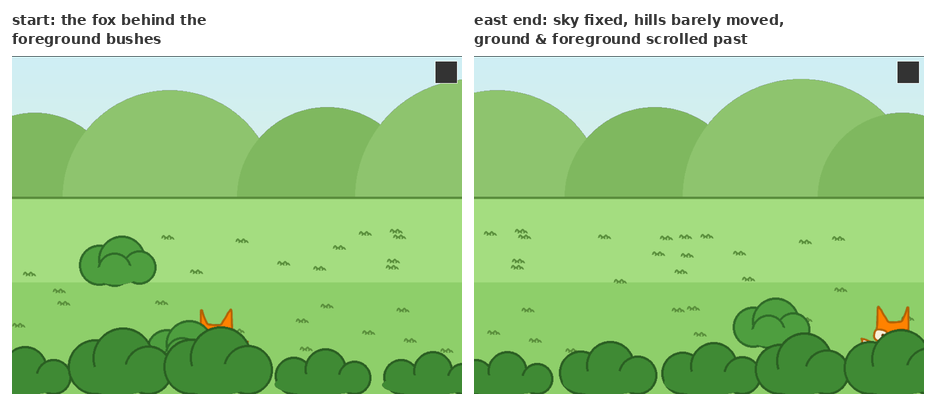
The fox can walk behind things, be far away, and roam a scene wider than the window. This post is the last piece of that plan — parallax planes — and the one where all of it finally shows up in the same picture. A scene’s background stops being one flat image and becomes layers, each scrolling at its own speed, so distance reads the way it does when you look out a train window: the near things race by, the far things barely move.
One number does the whole trick
A plane is almost nothing: an image, a position, and a parallax factor.
1
2
3
4
5
typedef struct plane {
  ImageData image;
  float parallax;   // 0 = fixed, 1 = scene-locked, > 1 = foreground
  SDL_Point origin; // top-left in scene coordinates
} Plane;
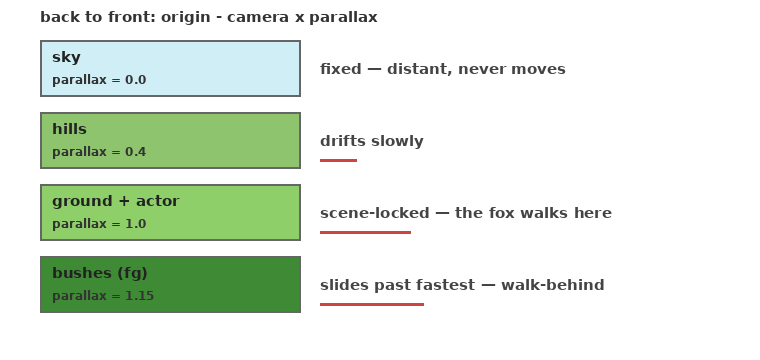
Every plane draws at origin - camera.pos * parallax, and that single
multiplication is the entire effect. A plane with parallax = 0 ignores the
camera completely — the sky, infinitely far away, never moves. A plane with
parallax = 1 tracks the camera one-to-one — it is the scene, the ground the
fox stands on. In between, parallax = 0.4 gives you hills that drift lazily
behind the action. And greater than 1 slides faster than the scene: a
foreground layer, nearer to the camera than the fox, that whips past as she
walks.
The scene struct
carries two ordered tables — bg_planes drawn behind the action, fg_planes
in front — and the scene declares them and nothing else. The engine loads,
draws, and frees them, exactly like it already did for
scene images.
The foreground plane is a free walk-behind
The first depth post gave the fox
y-sorted props so
she could stand in front of and behind an object. A foreground plane is the
cheaper cousin: a parallax > 1 strip in front of the action layer occludes
the actor with no prop, no baseline, no sorting. In the demo it’s a row of
bushes along the bottom of the screen — walk the fox low and she’s hidden
behind them up to the ears; there’s no case where she needs to stand in front
of them, so a plane is all it takes. Props are for the things she must be able
to pass on either side; planes handle the pure foreground.
Drawing in the right order
The render loop is a small dance, because the planes and the action layer live in different coordinate frames. The action layer draws through the camera offset set up in the last phase; each plane draws through its own offset instead. So a frame goes:
1
2
3
4
5
background planes   (each at origin - camera * parallax)
action layer        (through the shared camera offset)
foreground planes   (each at its own parallax offset)
debug overlay       (over everything, camera offset)
hub button          (screen space, no offset)
Getting that order and those offsets right is the whole engine change; the plane math itself is one line.
Where the spec and I disagreed
The plan came with a coverage rule: a plane must be big enough to fill the
window across the camera’s whole travel, or you’d see the empty clear-colour
at the edges. The formula even doubles as the spec you hand an artist —
image width ≥ WINDOW + parallax × (scene − WINDOW) — so a p = 0.4 hill
layer over a 1600-px scene needs to be 1120 px wide, and a p = 1 ground
layer the full 1600.
I wired it up as a load-time check and it immediately, correctly, complained — about the foreground bushes. And that’s when the rule and reality parted ways. The foreground is a partial strip: a bush row 140 px tall over a 600 px window. It’s supposed to leave most of the view uncovered — that’s what makes it a foreground and not a backdrop. So the coverage check now runs on background planes only, where a gap really would expose the clear colour; foreground planes are decorative overlays and exempt by nature. The spec described foreground planes as “a fence, a bush row” in the same breath as the coverage rule, so this is less a disagreement than a corner the plan hadn’t quite reconciled with itself.
The whole plan, in one field
The demo field that has grown alongside these four posts is now the proof that they compose. Its single flat background is gone, replaced by four planes — fixed sky, drifting hills, scene-locked ground, foreground bushes. Walk the fox across it and every feature is on screen at once: she’s y-sorted against the depth-band bushes, she shrinks to a far sprite when she climbs toward the horizon, the camera follows her across the 1600-px world, and the four layers slide past at four different speeds behind and in front of her. The suite is at 103 checks; the two real adventures declare no planes and are untouched.
That closes the depth plan — four independent PRs, each leaving the game playable, no scaling anywhere, and a fox who now lives in a world with a front, a back, and a horizon. What it’s waiting on now is not code but drawings: a real, hand-authored wide location for Vania or Gina to make all of this carry a scene that’s actually part of the story. The engine is ready for her; someone just has to paint the place.