A Puzzle Dependency Chart for the Pool Adventure
Category: SDL Adventure Game
This post was written with AI assistance.
The pool adventure has had a fixed puzzle structure for months, but that structure was never written down anywhere except the code. This post fixes that with the tool adventure game designers actually use for the job: the puzzle dependency chart, introduced by Ron Gilbert — he describes it in a post on Grumpy Gamer as “the single most important tool” behind Monkey Island’s puzzle design. There is a personal loop closing here: this whole project traces back to replaying The Secret of Monkey Island, and this is the first time I’m using its designer’s own planning tool on my own game.
What the chart is
A puzzle dependency chart is a graph, not a flowchart. Each node is a puzzle or a required step; an arrow means “this must be solved before that unlocks”. It deliberately says nothing about the order the player will actually do things in, and story beats stay out of it — only dependencies. Gilbert draws them backwards, starting from the goal and asking “what does this need?”, and reads the finished shape as a diagnostic: long single-file chains mean the design is too linear (his words: there is nothing worse), wide unconnected fans mean the player is drowning in choices. Good designs breathe — one puzzle opens a few, they reconverge at a bottleneck, the next act opens up.
The chart
Here is the real chart for the pool adventure, drawn from the shipped game logic:
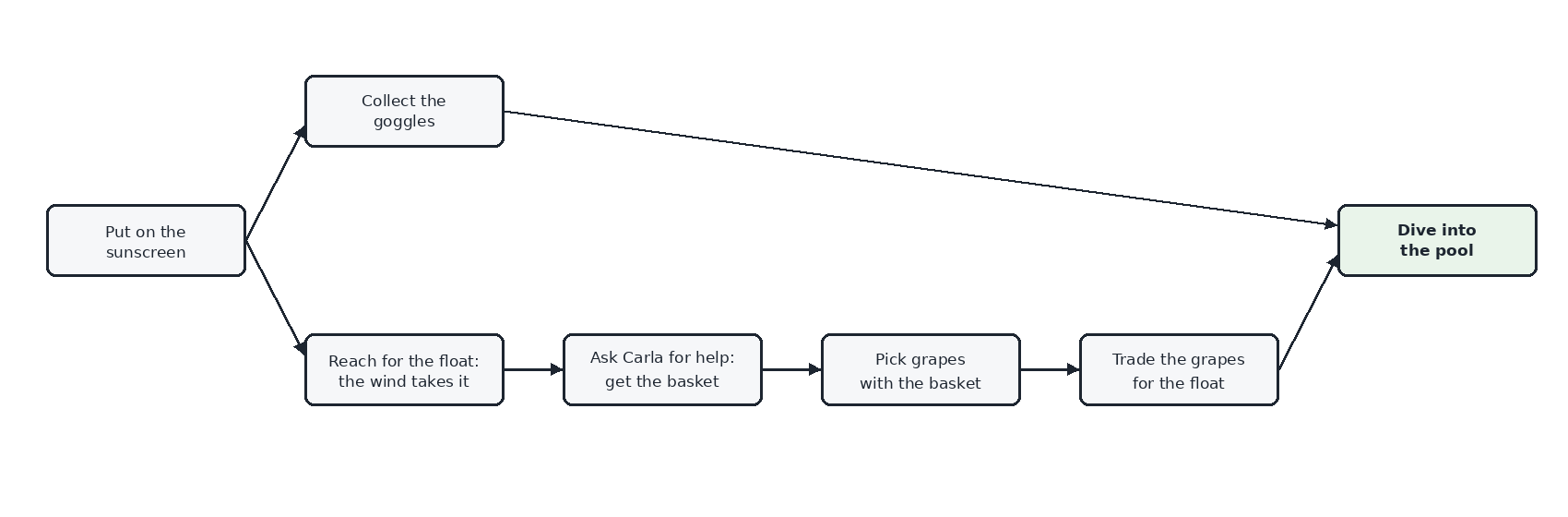
Seven nodes: put on the sunscreen (a minigame), collect the goggles, reach for the float and watch the wind carry it into the tree, ask Carla the crow for help and receive her basket, pick grapes with it (another minigame), trade the grapes for the float, and — with goggles and float — dive into the pool. The dive resets the state, so the adventure loops.
The chart was already in the code
This chart wasn’t designed on paper and then implemented; it was read off the code, because the dependencies already exist as data. The game state is five fields:
1
2
3
4
5
bool has_sunscreen;     // applied in the sunscreen minigame
bool has_goggles;
FloatState float_state; // AT_POOL -> STUCK_IN_TREE -> RETRIEVED
bool has_basket;        // given by Carla
bool has_grapes;        // collected in the grapes minigame
and every arrow in the chart is one of the
hotspot enabled predicates
or a check inside a callback. The goggles hotspot is enabled by
has_sunscreen && !has_goggles — that’s the sunscreen→goggles arrow. Carla
hands the basket over only while float_state == FLOAT_STUCK_IN_TREE —
that’s the gust→Carla arrow. The dive callback requires has_goggles and
FLOAT_RETRIEVED — the two arrows converging on the goal. Since the
hotspot refactoring made those predicates named, per-scene data, the chart
is close to being mechanically derivable from the tables.
What the shape says
Reading the chart the way Gilbert reads his:
- The sunscreen is a deliberate bottleneck. Every arrow flows through it — an “act break” before the poolside opens up. That’s intentional: the sun-safety ritual comes first, and it doubles as the tutorial.
- There is exactly one parallel branch. The goggles can be collected at any point relative to the float chain — before the gust, between any two of its steps, or last. That’s the diamond shape Gilbert wants, once.
- The float chain is the linear part. Four nodes in single file: gust → Carla → grapes → trade. By Monkey Island standards that’s the section the chart would send back for redesign. For this game’s audience — a toddler playing five-minute sessions — a short guided chain is closer to a feature than a flaw, but the chart shows exactly where a future puzzle would attach: a second branch out of the sunscreen bottleneck that reconverges at the dive, or a second thing Carla wants.
One more thing the chart exposed, about testing rather than design: the scripted playthrough that gates every commit walks exactly one topological order of this graph (goggles before the float chain). The chart says other orders are equally valid — goggles last, for instance — and none of them is asserted automatically. A second script permutation would close that gap cheaply.
The next adventure will get its chart before its code, drawn backwards from the goal. For a seven-node game the chart mostly confirms what was already in my head; the point of adopting the tool now is that the next design should be bigger — and the chart is the cheapest place to find out it breathes wrong.