From Imperative Click Handlers to Declarative Hotspots
Category: SDL Adventure Game
This post was written with AI assistance.
After a project health review, one refactoring stood out as worth doing right
away: every scene in the game handled clicks with the same hand-rolled
if-chain, and every scene wrote its interactions down twice. This post is
about replacing those chains with a table and a twenty-line dispatcher: instead
of implementing its click handling as control flow, each scene now declares
its interactions as data.
The same shape, six times
A point-and-click scene is, at heart, a list of “tapping this region does that thing”. But in the code, each scene expressed that list as a chain of conditionals in its mouse handler:
1
2
3
4
5
6
7
8
9
10
11
12
13
14
15
16
if (SDL_PointInRect(&m_pos, &GATE_HOTSPOT)) {
  walk_actor_to(fox, &walk_grid, (SDL_FPoint){GATE_POI.x, GATE_POI.y},
                true, maybe_open_gate);
  break;
}
// If key has been revealed yet skip this case
if (!has_key_been_revealed && SDL_PointInRect(&m_pos, &SHOVEL_HOTSPOT)) {
  walk_actor_to(fox, &walk_grid, (SDL_FPoint){SHOVEL_POI.x, SHOVEL_POI.y},
                true, maybe_dig_out_key);
  break;
}
// If key hasn't been revealed yet, or if key has been picked up already,
// then skip this case
if (has_key_been_revealed && !has_key &&
    SDL_PointInRect(&m_pos, &KEY_HOTSPOT)) {
  ...
Six scenes across two adventures, each with three to seven of these branches, all the same shape: maybe a state check, a rect test, a walk with a callback, break. The comments over the state checks — “if key has been revealed yet skip this case” — were doing the work the code should have been doing: naming the rule.
And there was a second copy. The debug
overlay draws every
hotspot rect, so each scene also kept an SDL_Rect array of its hotspots —
listing the same regions the if-chain tested, with nothing tying the two
together. Add a hotspot to the chain and forget the array, and the overlay
shows the wrong regions.
Move the behaviour into the table
The fix follows from the duplication: the rect table already exists — let it carry the behaviour too. A hotspot is now a struct:
1
2
3
4
5
6
7
typedef struct hotspot {
  SDL_Rect rect;
  bool (*enabled)(void); // NULL = always
  SDL_Point poi;         // where the actor walks before acting
  bool immediate;        // fire on the click itself, no walk
  void (*on_arrive)(void);
} Hotspot;
and a scene declares its interactions as data, in its init:
1
2
3
4
5
6
7
8
9
10
hotspots[i++] = (Hotspot){
    .rect = GATE_HOTSPOT, .poi = GATE_POI, .on_arrive = maybe_open_gate};
hotspots[i++] = (Hotspot){.rect = SHOVEL_HOTSPOT,
                          .enabled = key_still_buried,
                          .poi = SHOVEL_POI,
                          .on_arrive = maybe_dig_out_key};
hotspots[i++] = (Hotspot){.rect = KEY_HOTSPOT,
                          .enabled = key_on_the_ground,
                          .poi = KEY_POI,
                          .on_arrive = add_key_to_inventory};
One dispatcher in the engine walks the table — first enabled hotspot
containing the click wins, the actor walks to its poi and the callback fires
on arrival (or immediately, for navigation arrows and buttons) — and the
scene’s mouse handler shrinks to a single question:
1
2
3
4
if (hotspots_handle_click(hotspots, LEN(hotspots), fox, &walk_grid, m_pos)) {
  break;
}
// Otherwise: walk to the clicked point.
Table order is priority, exactly like the old chain’s top-to-bottom order,
so behaviour is unchanged by construction. The poi reuses the existing
walk-then-act machinery
— an exact-goal walk with a completion callback — so the dispatcher didn’t
need any new movement code.
My favourite part is what happened to the state checks. !has_key_been_revealed
inlined in a condition became a named predicate:
1
static bool key_still_buried(void) { return !has_key_been_revealed; }
The comment that used to explain the check is now its name. The squirrel
scene reads .enabled = squirrel_has_the_peg; the pool reads
.enabled = before_sunscreen. The sunscreen bottle, which used to be one
branch with two behaviours tangled inside, became two table entries: one
gated on before_sunscreen that walks over and starts the minigame, one on
after_sunscreen that just has Gina say she’s already done — the same
object meaning two things at different times, expressed as two lines.
The overlay reflects hotspot state for free
Because the table now records when a hotspot is active, the debug overlay can show it: enabled hotspots draw bright, gated-off ones dim. Here is the playground entrance before and after digging up the key — the shovel and key hotspots trade places, and you can see the scene’s state without clicking anything:
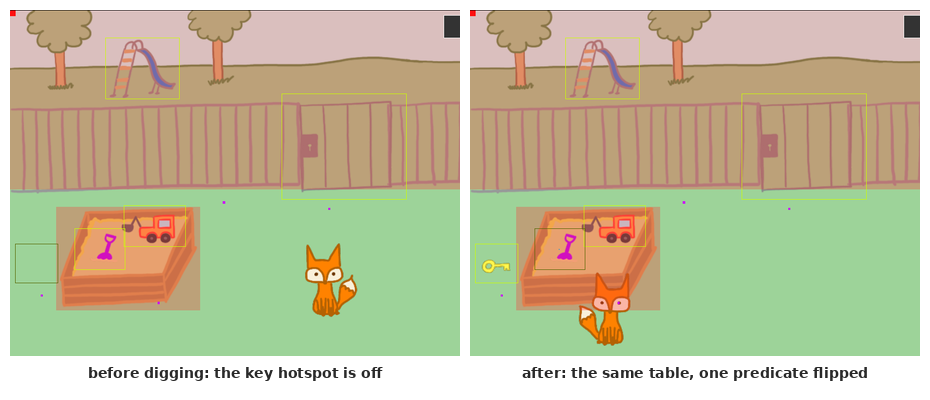
That’s the whole point of the single source of truth: the overlay stopped
drawing where hotspots are and started drawing what a click would actually
do right now. Before, that information existed only implicitly, scattered
through the if-chain.
The line count went up
I wrote an acceptance criterion for this task: net lines of code in the scenes should go down. It didn’t — the diff added about thirty more lines than it removed. The deleted lines were dense branches; the added ones are named predicates, forward declarations, and one struct literal per hotspot. Measuring simplicity in line count misses what changed: a scene’s interactions are now enumerable in one place, gating rules have names instead of comments, and the compiler-checked table replaces a convention nobody was checking. But the criterion was wrong and it’s worth saying so plainly, because “the diff is red” is such a tempting proxy for “the code got simpler”.
Not everything was forced into the table. The playground keeps a prelude
before the dispatch — after enough trips down the slide, any click ends the
scene — and the pool keeps its fall-through where Gina refuses to leave the
shade before her sunscreen is on. Escape hatches like these are why the
dispatcher returns false instead of forcing every case through the table: a
table for the regular cases, plain code for the two that aren’t.
Verification was the pleasant kind: the headless playthrough asserts the whole of Gina’s adventure dialogue in order, and it passed byte-identical. The fox’s chain — dig, key, gate, tree, squirrel, slide — I re-played in the browser, watching the overlay’s dim rects light up on cue as the story unlocked them.